INTRODUCTION⚓
Impossible d'accéder à la ressource audio ou vidéo à l'adresse :
La ressource n'est plus disponible ou vous n'êtes pas autorisé à y accéder. Veuillez vérifier votre accès puis recharger la vidéo.
ETUDE DE DEUX TRANSLATIONS SUCCESSIVES⚓
Activité⚓
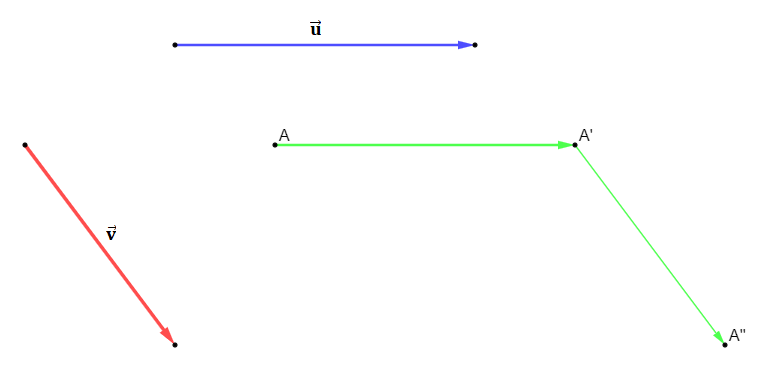
Propriété⚓
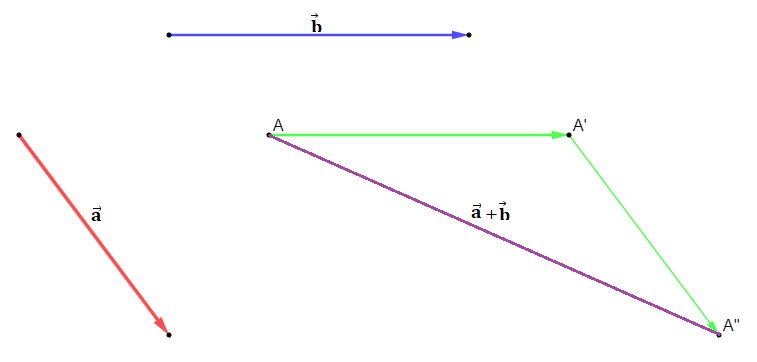
Soient \(\overrightarrow{a}\) et \(\overrightarrow{b}\) deux vecteurs distincts. Faire la translation de vecteur \(\overrightarrow{a}\) suivie de la translation de vecteur \(\overrightarrow{b}\) revient à faire la translation de vecteur \(\overrightarrow{a}\) \(+\) \(\overrightarrow{b}\).
Exercice d'application⚓
Question⚓
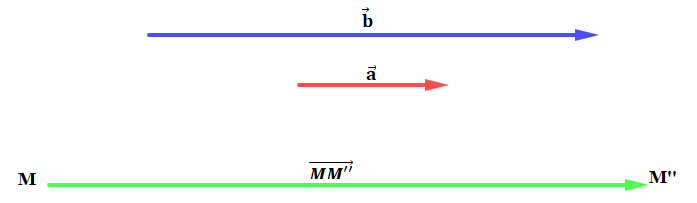
Soient \(\overrightarrow{a}\) et \(\overrightarrow{b}\) deux vecterus de même direction tel que \(\overrightarrow{b}=3\overrightarrow{a}\). Soit \(M\) un point du plan.
\(1)\) Construit l'image \(M''\) de \(M\) par la translation de vecteur \(\overrightarrow{a}\) suiuvie de la translation de vecteur \(\overrightarrow{b}\).
\(2)\) Montre que \(\overrightarrow{MM''}\) et \(\overrightarrow{a}\) sont colinéaires.
Solution⚓
\(1)\) Construction de l'image \(M''\) de \(M\) par la translation de vecteur \(\overrightarrow{a}\) suiuvie de la translation de vecteur \(\overrightarrow{b}\). Figure ci-contre.
\(2)\) Montrons que \(\overrightarrow{MM''}\) et \(\overrightarrow{a}\) sont colinéaires.
\(\overrightarrow{MM''}=\overrightarrow{MM'}+\overrightarrow{M'M''}\)
\(\overrightarrow{MM''}=\overrightarrow{a}+\overrightarrow{b}\)
\(\overrightarrow{MM''}=\overrightarrow{a}+3\overrightarrow{a}\)
\(\overrightarrow{MM''}=4\overrightarrow{a}\)
Donc \(\overrightarrow{MM''}\) et \(\overrightarrow{a}\) sont colinéaires.
ETUDE DE DEUX SYMETRIES CENTRALES SUCCESSIVES⚓
Activité⚓
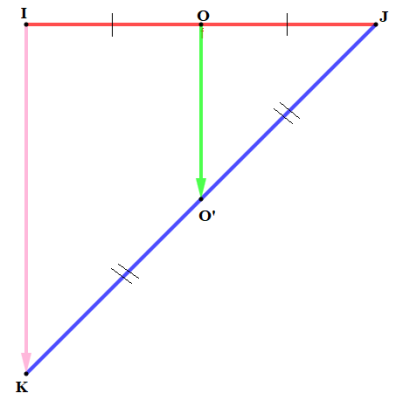
Propriété⚓
Soient \(O\) et \(O'\) deux oints distincts du plan. Faire une symétrie centrale de centre \(O\) suivie d'une symétrie centrale de centre \(O'\) revient à faire la translation de vecteur \(2\overrightarrow{00}'\).
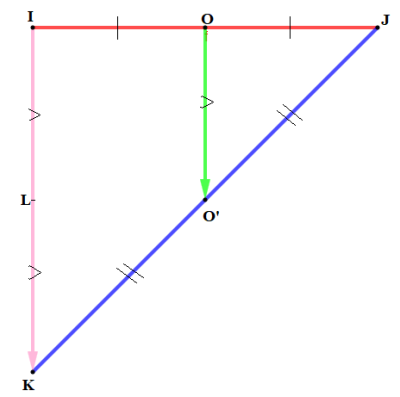
Exercice d'application⚓
Question⚓
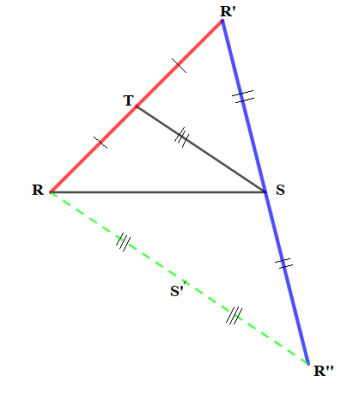
Soit \(RTS\) un triangle.
\(1)\) Construis le point \(R'\) image du point \(R\) par la symétrie de centre \(T\).
\(2)\) Construis le point \(R''\) image du point \(R'\) par la symétrie de centre \(S\).
\(3)\) Montre que \(\overrightarrow{RR''}\) \(=\) \(2\overrightarrow{TS}\) sont colinéaires.
Solution⚓
\(1)\) et \(2)\) Voir figure.
\(3)\) Montrons que \(\overrightarrow{RR''}=2\overrightarrow{TS}\)
\(\overrightarrow{RR''}=\overrightarrow{RR'}+\overrightarrow{R'R''}\)
\(\overrightarrow{RR''}=2\overrightarrow{TR'}+2\overrightarrow{R'S}\)
\(\overrightarrow{RR''}=2(\overrightarrow{TR'}+\overrightarrow{R'S})\)
\(\overrightarrow{RR''}=2\overrightarrow{TS}\)
Donc \(\overrightarrow{RR''}=2\overrightarrow{TS}\)
ETUDE DE DEUX SYMETIRIES ORTHOGONALES SUCCESSIVES⚓
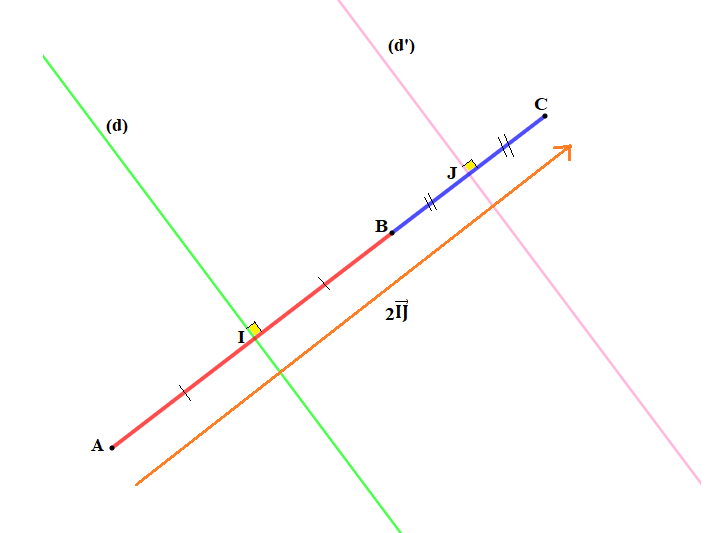
Les deux droites sont strictement parallèles⚓
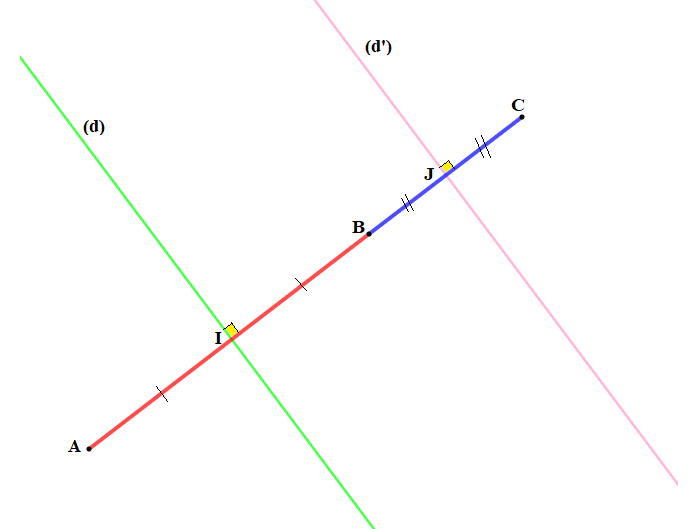
Les deux droites sont perpendiculaires⚓
Propriété
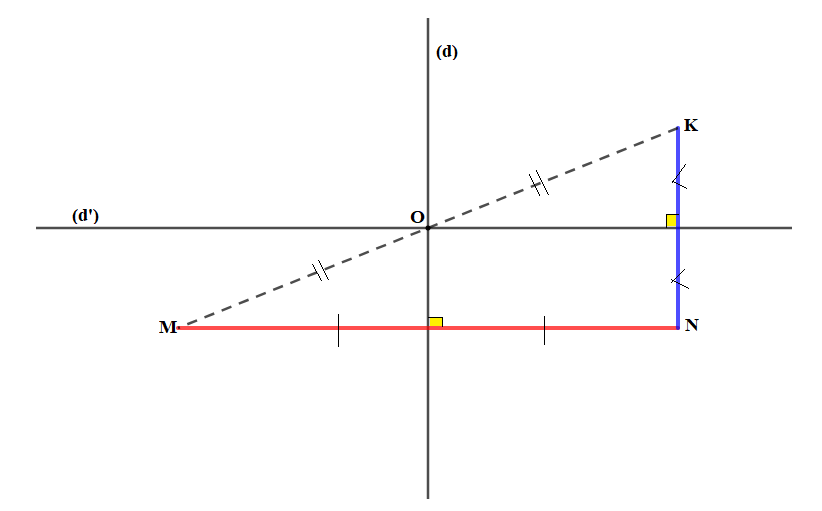
Soient \((d)\) et \((d')\) deux droites perpendiculaires en un point \(O\). Faire la symétrie orthogonale d'axe \((d)\) suivie de la symétrie orthogonale d'axe \((d')\), revient à faire la symétrie centrale de centre \(O\).
Les deux droites sont sécantes en un point I⚓
Propriété
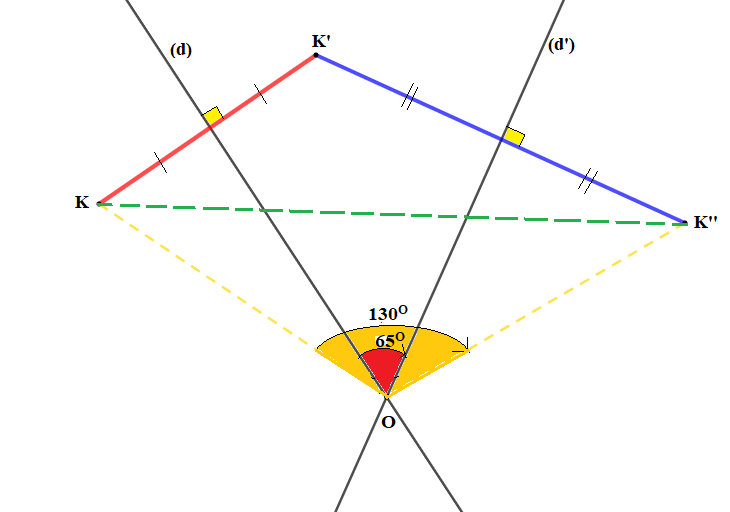
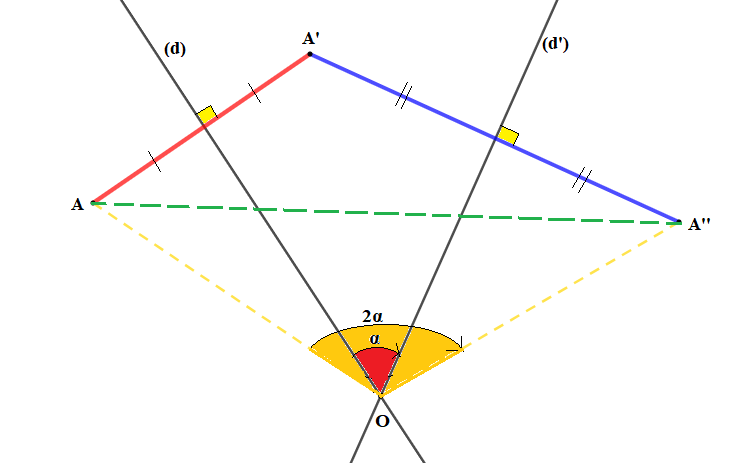
Soient \((d)\) et \((d')\) deux droites perpendiculaires en un point \(O\) et formant un angle \(\alpha\). Faire la symétrie orthogonale d'axe \((d)\) suivie de la symétrie orthogonale d'axe \((d')\), revient à faire la rotation de centre \(O\) et d'angle de mesure \(2\alpha\).
Exercice d'application⚓
Question⚓
\(1)\) Place un point \(K\) dans le plan.
\(2)\) Trace deux droites \((d)\) et \((d')\) sécantes en \(O\) et formant un angle de \(65^o\).
\(3)\) Construis le point \(K'\) image de \(K\) par la symétrie d'axe \((d)\) puis onstruis le point \(K''\) image de \(K'\) par la symétrie d'axe \((d')\). Que représente \(K''\) pour \(K\) ?